

 Frozen in Time: The German Startup Offering Customers a Second Chance at LifeTomorrow.Bio and the Fascinating — and Controversial — World of Human Cryopreservation
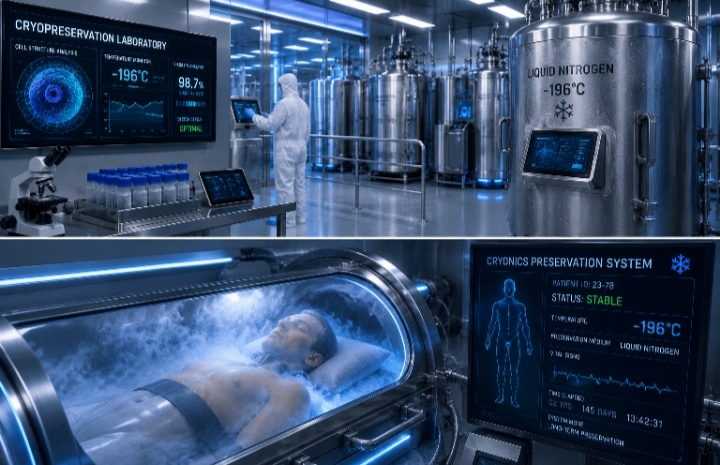
It sounds like the plot of a science fiction movie, but for a Berlin-based startup called Tomorrow.Bio, this question is not just philosophical — it is a business model. The company offers to cryogenically preserve your body at the moment of legal death and store it indefinitely, betting that future medical science will one day be advanced enough to revive you, treat whatever killed you, and give you a second chance at life.
We fact-checked this story. It is real. And it is more developed than you might expect.
Who Is Tomorrow.Bio?
Tomorrow.Bio was founded in 2020 in Berlin, Germany, by Dr. Emil Kendziorra — a trained medical doctor and former cancer researcher — and Fernando Azevedo Pinheiro, an industrial and civil engineer with a background in tech entrepreneurship. Together, they set out to build what is now recognised as Europe's first dedicated cryonics laboratory.
The company's core offering is straightforward in concept, though extraordinary in ambition: when you die, they freeze your body in liquid nitrogen at -196°C (approximately -320°F), preserving your cells, tissues, and brain structure in a state of suspended animation — known scientifically as "biostasis" — until future technologies can revive you.
 m
m
The company has since attracted more than 800 registered members, raised €5 million in seed funding, accumulated over €160 million in pre-contracted commitments, and expanded its operations into the United States — with presence in New York, California, and Florida.
How Does Cryopreservation Actually Work?
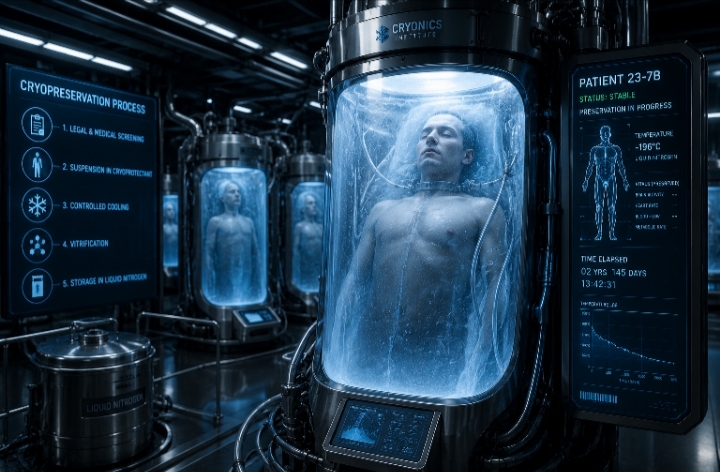
Contrary to the popular imagination of "freezing" a body like food in a refrigerator, cryopreservation is a highly technical medical procedure. Here is how Tomorrow.Bio's process works:
Step 1: Immediate Response
The moment legal death is pronounced, Tomorrow.Bio's Standby Support Teams (SST) — based in cities including Berlin and Zurich — are deployed in specially equipped cryo-ambulances. These teams perform chest compressions and supply oxygen to slow decomposition while the body is being transported. Speed is critical: the faster the process begins, the better the quality of preservation.
Step 2: Cryoprotectant Perfusion
All body fluids are replaced with a cryoprotectant solution — a medical-grade antifreeze-like substance. This is one of the most important steps, because ordinary freezing creates ice crystals that rupture cells and destroy tissue. The cryoprotectant prevents ice crystal formation entirely, a process known as vitrification, allowing the body to pass through sub-zero temperatures without crystalline damage.
Step 3: Cooling and Storage
The body is then gradually cooled to -196°C, the temperature of liquid nitrogen, and placed in an insulated steel container. This container is transported to Tomorrow.Bio's long-term storage facility in Rafz, a village in Switzerland, operated by its partner organisation, the European Biostasis Foundation (EBF). At this temperature, all biological processes cease completely and indefinitely — neither the body deteriorates nor changes.
Step 4: Quality Control via CT Scanning
Every person cryopreserved by Tomorrow.Bio is CT-scanned at -196°C before entering long-term storage. The scans are colour-coded to assess how well the cryoprotectant solution has penetrated all body tissue. This allows the company to track preservation quality and continuously improve its procedures.
What Does It Cost?
Tomorrow.Bio offers two main service tiers:
Whole-Body Preservation: approximately $200,000 USD (€180,000)
Brain-Only (Neuropreservation): approximately $80,000 USD
These costs are typically financed through a life insurance policy, which members take out at the time of signing up, making the monthly premium — which Tomorrow.Bio claims can be as low as €30/month for younger members — significantly lower than the lump sum suggests. The company encourages early sign-up, noting that younger members secure lower insurance premiums and protect themselves against developing medical conditions that might make them uninsurable later.
Where Are They Now? The Current Numbers
As of early 2025, Tomorrow.Bio has successfully cryopreserved 20 people and 10 pets, with more than 800 additional individuals signed up and awaiting their eventual preservation. The company has raised €5 million in seed funding — co-led by investment firms Blast.Club and Truventuro — and plans to use the funds to:
Expand its standby support teams across Europe and the United States
Intensify research and development into better cryoprotectant solutions
Develop rewarming technology (currently the biggest scientific gap)
Offer longevity consulting services beginning in 2026
Their 2026 roadmap focuses on improving preservation quality metrics through ultrastructural analysis — going beyond CT scans to examine tissue at the cellular level — while building out more cryo-ambulance coverage in the US to match European response capabilities.
What Does Science Say? The Big Debate
Here is where it gets complicated — and where intellectual honesty demands balance.
The Case FOR Cryonics
Cryopreservation of embryos, sperm, eggs, and some organs is already standard medical practice. The science of low-temperature preservation is real and advancing.
Proponents argue that the current definition of "death" is medically flexible — people have been revived after prolonged cardiac arrest, particularly in cold conditions. What we call death today may be considered treatable by future medicine.
Academic researchers note there is a "small, yet non-negligible" chance that cryonics is technically feasible, particularly when future developments in nanotechnology and molecular biology are considered.
The vitrification technique used today significantly reduces ice crystal damage compared to earlier methods, representing genuine scientific progress.
The Case AGAINST Cryonics
Many mainstream scientists consider cryonics a pseudoscience. Cryobiologist Kenneth Storey stated that cryonics "will never be possible" and would require overturning fundamental laws of physics, chemistry, and molecular science.
No complex organism — not even a small animal — has ever been successfully cryopreserved and revived. The gap between preserving and reviving is enormous and currently unbridged.
The rewarming problem: even if cells are preserved without ice crystal damage, uniformly and safely rewarming a full human body remains unsolved.
A 2022 scientific review estimated a mean projected revival timeline of 82 years — meaning no one currently cryopreserved is expected to be revived this century, at the earliest.
Bottom line: The science of cryopreservation is real. The science of revival from human cryopreservation does not yet exist. Tomorrow.Bio is transparent about this, stating that patients are stored "until scientific and technological advancements enable the possibility of revival."
The Ethical and Philosophical Questions
Even if cryonics becomes scientifically feasible in the future, the ethical questions are profound:
Social inequality: If only the wealthy can afford revival, does cryonics create a world where financial resources literally determine who gets to live again? As one commentator put it, in a future where cryonics is commonplace, it may not be sin that determines mortality — it may be poverty.
What is death? Cryopreservation fundamentally challenges our legal, medical, and spiritual understanding of where life ends. Who has authority over a cryopreserved body — the family, the company, or the individual themselves?
Identity and continuity: Even if a body is successfully revived centuries in the future, is the person who wakes up truly the same person? Would memories, relationships, and personality be intact?
Religious perspectives: Most world religions — including Christianity, Islam, and African traditional beliefs — have well-established frameworks for understanding death. Cryonics challenges or contradicts many of these frameworks directly.
Corporate longevity risk: What happens to cryopreserved bodies if the company goes bankrupt or ceases to operate? Tomorrow.Bio currently uses the Tomorrow Patient Foundation (TPF), a Swiss non-profit, as the legal guardian of preserved patients — a structural safeguard, but not an absolute one.
What This Means for Africa and Nigeria
Currently, Tomorrow.Bio is focused entirely on Europe and North America. Nigeria and Africa are not on its service map. But the existence of this technology invites important reflection for Nigerians:
It is a reminder that global science and technology are moving at extraordinary speed, redefining possibilities that previous generations considered fixed — including death itself.
For students — particularly those studying biology, chemistry, medicine, or technology — this is a real-world demonstration of how fields like cryobiology, nanotechnology, and molecular medicine are converging.
It raises an urgent question about the global ethics of emerging technologies: who gets to participate, who gets to benefit, and who will be left behind?
Final Thoughts: Science, Hope, and Caution
Tomorrow.Bio occupies an unusual space — between science and speculation, between hope and hubris. The company is not making fraudulent claims; it is transparent that revival technology does not yet exist. What it offers is a wager on the future: the bet that science will advance far enough, in time, to honour the gamble.
Whether you find this inspiring, disturbing, or merely interesting depends greatly on your scientific beliefs, spiritual convictions, and financial reality. But one thing is certain: Tomorrow.Bio is not science fiction. It is an operating company, with paying members, cryopreserved patients, a Swiss facility, and a growing global footprint.
The question of whether those 20 preserved individuals will ever be revived remains unanswered — and may remain so for generations. But the ambition behind the question is forcing scientists, philosophers, ethicists, and policymakers to think very carefully about what it means to be alive, and what it might mean to die.
"During our lifetime, we may witness the safe cryopreservation and reanimation of complex organisms."
— Fernando Azevedo Pinheiro, Co-founder, Tomorrow.Bio
EDITOR'S NOTE
This article is intended for educational purposes and was fact-checked against multiple international sources including Tech.eu, The Express Tribune, Wikipedia's cryonics entry, and peer-reviewed scientific literature. Shadeland Tutors does not endorse cryopreservation services. Readers are encouraged to form their own informed opinions on this emerging and deeply complex topic.
Tags: Science | Technology | Cryonics | Future of Medicine | Ethics | Emerging Technologies
© 2026 Shadeland Tutors Ltd. All rights reserved.